Lithium-Ion Battery Chargers: A UK Compatibility and Safety Guide
Check a lithium-ion battery charger by chemistry, pack configuration, maker approval, output, connector, polarity, current and safe charging practice.
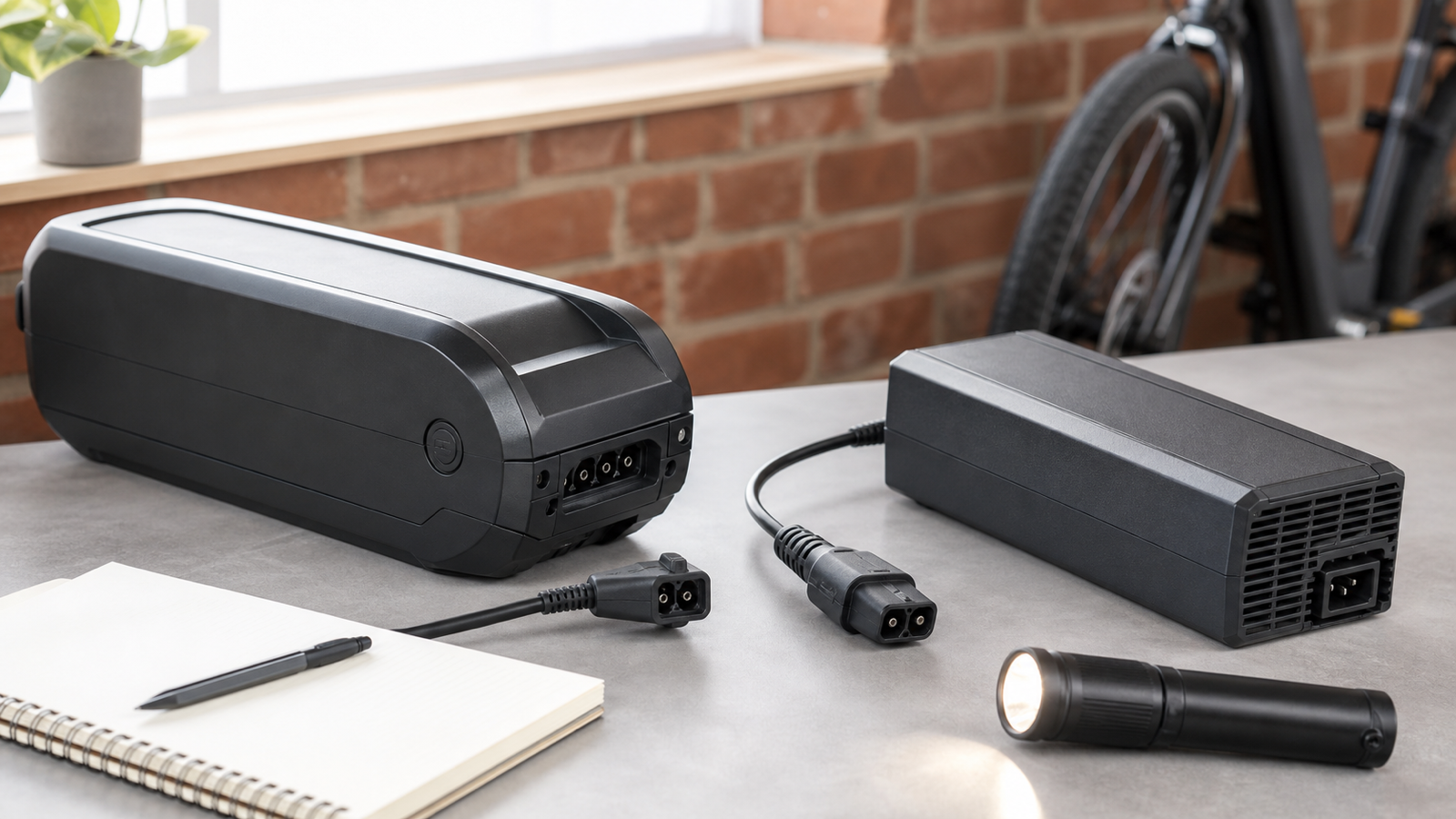
A connector that fits is not evidence of charger compatibility. Before connecting a replacement charger, you need the battery maker’s approval or an exact match for the chemistry, pack configuration, charge profile, output voltage, current, connector and polarity. A “48V” product title does not supply all of that information.
This matters most with e-bikes, e-scooters, mobility products and conversion kits, where a large battery stores enough energy for a fault to become a fast-moving fire. The UK’s Office for Product Safety and Standards says not all batteries and chargers are compatible or safe together and advises using the manufacturer’s recommended battery or charger.
If the original specification cannot be established, do not solve the gap with an adapter or a marketplace listing. Ask the vehicle, battery or drive-system manufacturer, or a competent repair professional who can identify the pack.
Identify the battery before shopping
Photograph the complete battery, its rating label, charge port, original charger label and the product it powers. Record the manufacturer, exact model, serial or part number, nominal voltage, chemistry, capacity and any stated charging input. Also record whether the battery is original, a replacement or part of a conversion kit.
Do not rely on case shape. Similar enclosures can contain different cell arrangements, battery-management systems and charge ports. Do not open a battery to count cells or inspect wiring; opening or modifying a pack can create short-circuit, shock, fire and warranty risks.
The safest route is an authorised replacement named for the exact battery or complete product. The OPSS e-bike and e-scooter safety message says to follow the manufacturer’s instructions and use the recommended battery or charger.
Nominal voltage is not charger output voltage
Battery names usually describe a nominal system voltage, not the voltage a charger should blindly deliver. The required charging limit depends on cell chemistry and the number of cells connected in series. A battery-management system is a safety layer, not permission to use an arbitrary higher-voltage supply.
Two packs sold as “48V” can differ in chemistry, configuration, charge limit, connector and communication requirements. Therefore, never infer an output voltage from the marketing name alone. Match the approved charger model or the battery maker’s written charging specification.
Check the charger’s output label, not only its UK mains input. The output must match the battery specification exactly where the maker requires an exact value. A lower or higher figure is not a safe experiment, and an adjustable bench supply is not automatically an approved lithium-ion charger.
Check all compatibility fields
Treat the following as one compatibility record:
- Battery chemistry. A charger intended for a different lithium chemistry or for lead-acid batteries may use an unsuitable charge profile.
- Pack configuration and approved charge voltage. Confirm from the maker’s documentation or exact original charger.
- Charge current. A higher current can exceed the battery, connector or BMS design; a lower current is not automatically approved either.
- Connector. Match the complete keyed connector, pin count and mechanical fit.
- Polarity and pin function. Identical-looking connectors can be wired differently. Never reverse pins or build a guesswork adapter.
- Communication or enable requirements. Some systems identify authorised chargers or use additional contacts.
- Mains input and plug. Use a product intended for the UK supply and follow its instructions; travel adapters do not fix an incompatible DC output.
- Manufacturer authorisation. The strongest evidence is the exact battery or vehicle maker naming the replacement charger.
Keep a screenshot or PDF of the compatibility statement with the receipt. Marketplace sellers and product pages can disappear, and a title may be reused across several variants.
Safety marks are not the whole decision
UKCA or CE marking, supplier identity and traceable instructions are useful product checks, but a mark does not prove that a charger matches your battery. Look for a responsible UK seller, a clear model number, electrical ratings, safety instructions and a route for faults or recalls. Be wary of missing manufacturer details, contradictory labels, unusually light enclosures, loose plugs or listings that claim one charger is universal across many voltages.
OPSS’s Buy Safe, Be Safe guidance recommends buying from a known seller, checking compatibility and using manufacturer-recommended replacement parts. It also points consumers to the UK’s product-safety alerts and recalls service.
Before using a newly purchased charger, compare its delivered model and output label with the order and approval record. If they differ, do not connect it.
Charge in a place that protects your escape route
Follow the product instructions, but use these OPSS principles as a minimum behaviour check:
- charge while awake and present, not while asleep or away;
- keep batteries and chargers away from exits and escape routes;
- do not cover the charger or battery;
- unplug when charging is complete;
- keep the area clear of easily combustible material;
- do not charge a damaged, swollen, wet, unusually hot or modified battery;
- stop using equipment that smells unusual, hisses, cracks, smokes, deforms or performs abnormally.
Do not charge immediately after a battery has become very hot or cold; follow the manufacturer’s stated temperature range. Keep the charger on a stable surface where its ventilation openings remain clear. Do not daisy-chain extension leads or route cables where they will be crushed.
If a lithium-ion battery emits smoke or enters thermal runaway, leave the area, call 999 and follow fire-service advice. Do not put yourself at risk trying to carry or extinguish it.
Used batteries, conversions and unknown packs
Second-hand and conversion-kit batteries need more evidence, not less. Ask for the original invoice, model documentation, charger and modification history. A repacked battery may no longer match the label on its case. A missing label or home-made adapter is a reason to stop.
OPSS’s statutory e-bike battery guidelines explain how incompatible components and use outside safe design parameters can contribute to thermal runaway. The guidance is directed at producers and distributors, but it shows why the complete battery, BMS and charger system matters.
Use a competent professional for conversion and repair work. Do not bypass the BMS, replace a connector merely to make a charger fit, increase charge current or attempt cell-level repair from an online video.
A replacement-charger checklist
Before ordering, be able to answer yes to every line:
- I know the battery and powered-product make and exact model.
- I have the maker’s charging specification or named replacement-charger model.
- Chemistry, approved output voltage and charge current match.
- Connector, keying, pin function and polarity match without an adapter.
- The seller, product model and electrical ratings are traceable.
- The charger is supplied for UK use with clear safety instructions.
- The battery is undamaged, unmodified and within the maker’s service limits.
- I have a ventilated charging place that does not block an exit.
If any answer is no, pause the purchase. The cost of obtaining an authorised charger or a professional battery assessment is part of owning the system safely.
The practical rule is simple: match the whole charging system, not the plug and not the nominal-voltage headline. When the evidence is incomplete, uncertainty is a stop signal.
For other site guides, use the SDTYYP Battery Blog index. It is general navigation and is not a compatibility database for a specific battery.